
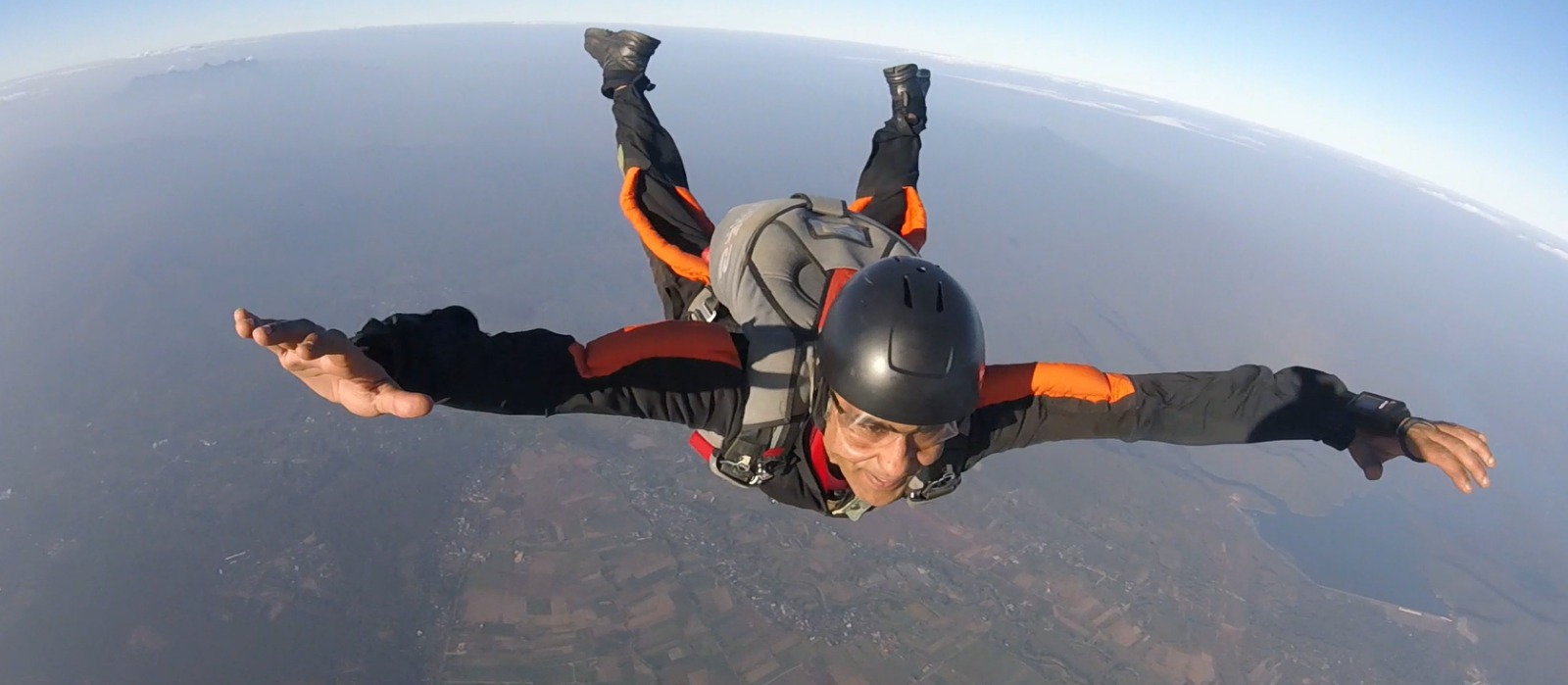
1. Early years & formative influences
My childhood was a training ground for a question I
didn't yet know how to ask: Where is Home? Growing up in an environment where
discipline was the language and curiosity was the currency, I was quietly
taught that the world is a map waiting to be decoded.
The
Seed:
I realized early that most people live in a "Hanger", a place of
safety that eventually becomes a cage of stagnation. My formative years were
spent watching the horizon, wondering why some people fly while others merely
stay grounded by fear. This "Aerodynamic" view of life, seeing
challenges as wind resistance that can actually provide lift, became the
foundation for my military career and, eventually, my writing.
2. Education & the making of perspective
My academic journey (JNU, IIM Ahmedabad) provided the
intellectual "Airframe," but it was the gaps between the lectures
that mattered. I was studying geopolitics and management, but my personal life
was a laboratory of human connection.
The
Shift:
I began to see that intellectual brilliance is useless if you are emotionally
"stalled." During these years, I navigated the complex "Linear
Mind" of academia, only to realize that the most potent questions, the
ones about Love and belonging, cannot be solved with an equation. This led to a
meaningful shift: I stopped looking for "Home" in a coordinate on a
map and started looking for the "Aerodynamics" that allow a heart to
feel at home anywhere.
3. Career beginnings & key turning points
Stepping into the professional life of a soldier, I
encountered the "Linear Reality" of SOPs and battlefields. The
turning point wasn't a promotion; it was a realization during a moment of
profound personal silence.
The
Pivot:
I had mastered the art of "conquering" territory, but I was failing
at the art of "surrendering" to Love. I saw high-ranking
professionals who could manage a thousand men but couldn't manage a single
heartbreak. This redirected my path: I decided to apply the same strategic
rigor I used in geopolitics to the most chaotic human experience, Love. I
wanted to find the "Black Box" of why relationships fail despite the
best intentions.
4. From professional life to storytelling through travel
The Aerodynamics of Love (and Mayan Routes, Indian
Roots) isn't a textbook because you cannot teach a bird to fly by showing it a
diagram. You have to tell the story of the flight.
The
Motivation: I wrote this because I hit a "Floor" in my
own life, a moment where the person I loved was at her weakest, and I was
helpless. I realized that the "Academic" answer wasn't enough for the
"Nari Yodha" in front of me. I had to narrate the journey of
"Flight" versus "Anger." This travelogue is a lived
experience of how Central American landscapes and Indian spiritual roots
(Mirabai, Radha, Krishna) converged to answer the two most crucial questions in
the world: What is Home? and What is Love? Readers will find that the answer
isn't a definition; it's a "State of Being."
5. Present identity & evolving purpose
Beyond the titles of Author or Soldier, I define myself
as an Explorer of the Satvik State. My purpose has evolved from "Taking
Ground" to "Giving Space."
The
Evolution: My travels and personal challenges, including being
blocked by the person who inspired my book, reshaped my sense of leadership. I
now understand that true leadership is being the "Cheerleader" in
someone else’s fight, even if you aren't in the ring with them. I am a writer
who wants to help people dismantle the "Box" they’ve built around
their hearts so they can finally see the "Diversity of the Divine."
6. Learnings, resilience & message to readers
The most testing challenge wasn't a physical war; it was
the "Bathinda Dance Floor" moment, seeing the one I loved happy with
someone else. Most people would call that a defeat. I call it my
"Graduation."
The
Message:
To the readers searching for meaning: You are likely suffering from "The
Dot on the Whiteboard Syndrome." You are obsessed with the one
"No," the one flaw, the one heartbreak, and you are missing the
infinite whiteness of the universe around you.
The
Takeaway: If you have ever stood on your own “Bathinda Dance
Floor” hollow, grounded, certain the sky was no longer yours know this: the
"Hanger" of anger and regret is not your destination. It is simply
where you refuel. The "Radha Paradox" teaches us that the deepest
love does not anchor you to one person; it teaches you to navigate by your own
internal compass. And "Aerodynamic Lift" is not something you earn it
is something you remember. Home is not a person you find, but a state of being
you return to. Vineet’s story is a reminder that the “Floor” is never the end
it is the runway. And for those willing to understand the Aerodynamics of Love,
the sky doesn’t just remain. It expands.